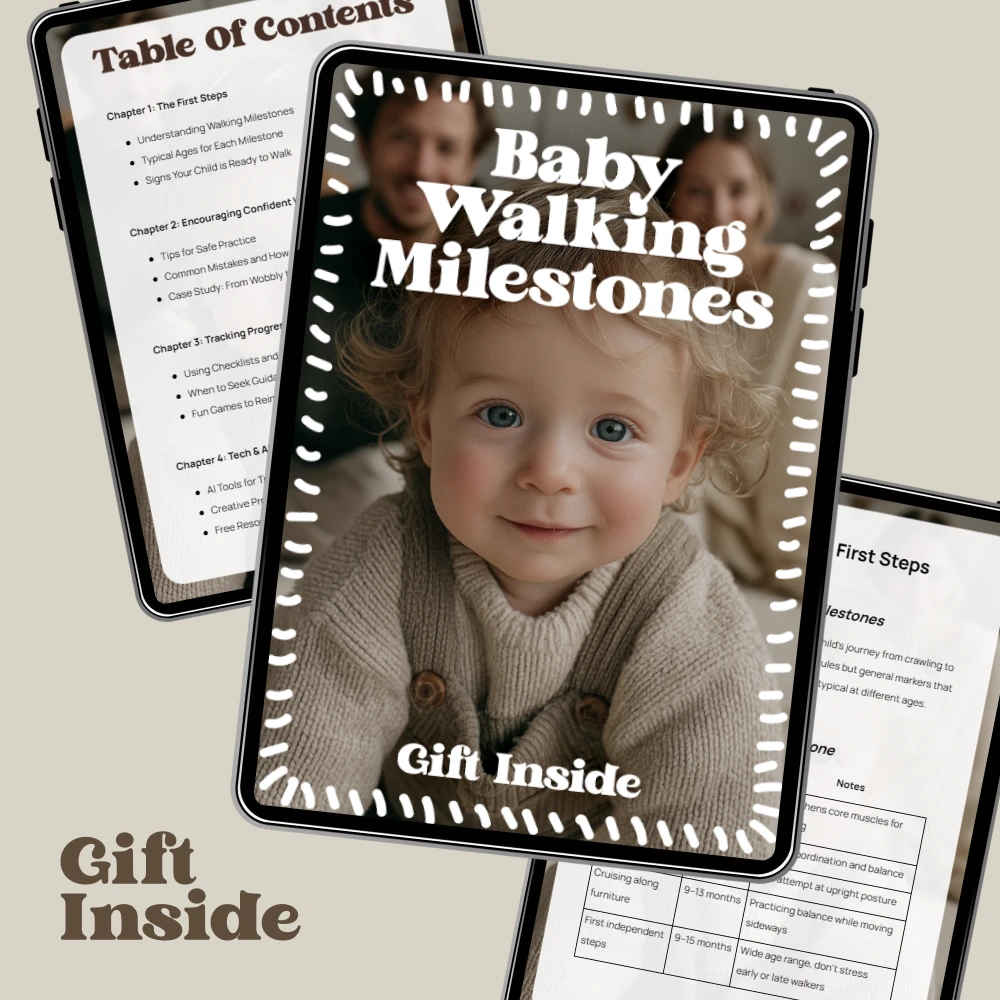
Baby Walking Milestones: From Pulling Up to First Steps

Walking takes strength, balance, and coordination. Many babies begin by getting into a standing position and pulling up on furniture. They may then “cruise” sideways while holding on, let go for a moment, or try to move between nearby supports. Independent steps can emerge from all that practice.
These skills do not have to arrive in a rigid sequence. One baby may spend weeks cruising; another may seem more interested in standing still. The table below is a quick reference to selected CDC milestones, not a deadline or a way to diagnose a delay. The CDC describes milestones as skills that most children—75% or more—can do by a given age.
Walking-related milestones to notice
| Age | Skill to look for | What you can do |
|---|---|---|
| Around 12 months | Pulls up to stand and walks while holding on to furniture | Offer stable furniture and supervised floor space. |
| Around 15 months | Takes a few steps independently | Make short, clear paths for practice. |
| Around 18 months | Walks without holding on | Encourage movement through everyday play. |
You can read the CDC’s milestone lists for 1 year, 15 months, and 18 months for more context.
Longer stretches of cruising, a brief unsupported stand, or a controlled return to the floor can show your baby practicing balance. None tells you exactly when the first step will happen.
A short weekly note is more useful than a guess. Record the date, the movement you saw, the support your baby used, and any question you want to ask at a checkup. Our Baby Walking Milestones Guide is an optional tracker and first-steps checklist if you prefer one place for those observations. It cannot diagnose a delay.
Featured in this guide
Baby Walking Milestones Guide | Walking Milestones Tracker, First Steps Support, Confident Walking Checklist for Parents
Clear cords and small objects from the floor, protect sharp corners, and offer stable furniture that will not tip when your baby pulls up. Stay close during practice, but let your baby choose when to move between supports.
On a safe indoor surface, barefoot time lets your baby feel the floor. When shoes are needed for protection, choose a flexible pair that fits well. Do not pull your baby forward by the arms or force steps. Avoid wheeled baby walkers; they can cause injuries and do not teach walking.
If your child is not walking independently by 18 months, ask your pediatrician for an evaluation. If a 2-year-old is not walking, arrange a prompt medical assessment. You can raise concerns earlier, especially if your child loses a skill.
If your baby was born prematurely, ask your clinician how corrected age applies. Bring your dated observations so you can discuss what your child does now, not just when you expected walking to begin.
You can raise a concern at any time. Contact your pediatrician if progress seems to stall, your child loses a skill they previously had, or movement seems noticeably uneven. You do not have to wait for a particular birthday to describe what you are seeing.
The CDC lists walking without holding on as an 18-month milestone. If your child is not walking independently by then, ask your pediatrician for an evaluation. If a 2-year-old is not walking, arrange a prompt medical assessment rather than continuing to wait. A clinician can consider your child’s full history and development; a milestone list cannot identify the cause on its own.
If your baby was born prematurely, ask your clinician how corrected age applies when you discuss milestones. Our team’s practical advice is simple: keep the record factual, make space for safe play, and use your pediatrician as your partner when something worries you.
The A Parent’s Guide to the Crib-to-Bed Transition | Toddler Sleep Ebook for a Smooth toddler transition from crib to bed | Gentle Parenting Digital Guide works alongside the featured product; it provides a defined sleep surface during family stops and overnight travel.
There is no single age at which every baby “should” take a first step. As reference points, the CDC lists taking a few independent steps at 15 months and walking without holding on at 18 months.
Pulling to stand, cruising, briefly standing without support, and trying to move between supports are signs of developing balance and coordination. None predicts an exact first-step date.
Key skills include pulling up to stand, cruising along furniture, balancing without support, taking a few independent steps, and walking without holding on. Babies may practice these skills in different ways rather than following an exact sequence.



Leave a comment